Tolerance is a decision, not an accident
Every dimension you make will be slightly off. Tolerance is how far off you decide to allow it to be. The ISO 286 system gives that decision names: a letter for where the tolerance zone sits relative to the nominal size and a number for how wide the zone is. A shaft-and-bore pair written as H7/g6 is a classic close sliding fit — it turns or slides smoothly with very little play.
Here is what that means at 8 mm, the size of a 608 bearing bore and a common hobby shaft:
| Feature | Class | Deviation from 8.000 mm |
|---|---|---|
| Bore | H7 | 0 to +0.015 mm |
| Shaft | g6 | −0.005 to −0.014 mm |
| Resulting clearance | H7/g6 | 0.005 to 0.029 mm |
Those are machined-metal numbers. A typical consumer FDM printer cannot hold anything close to 15 microns; layer lines alone are often ten times that. The lesson is not to give up on precision but to put it where it belongs: let a purchased bearing, ground rod or reamed bushing supply the tight fit, and let printed parts simply hold those precise components in place.
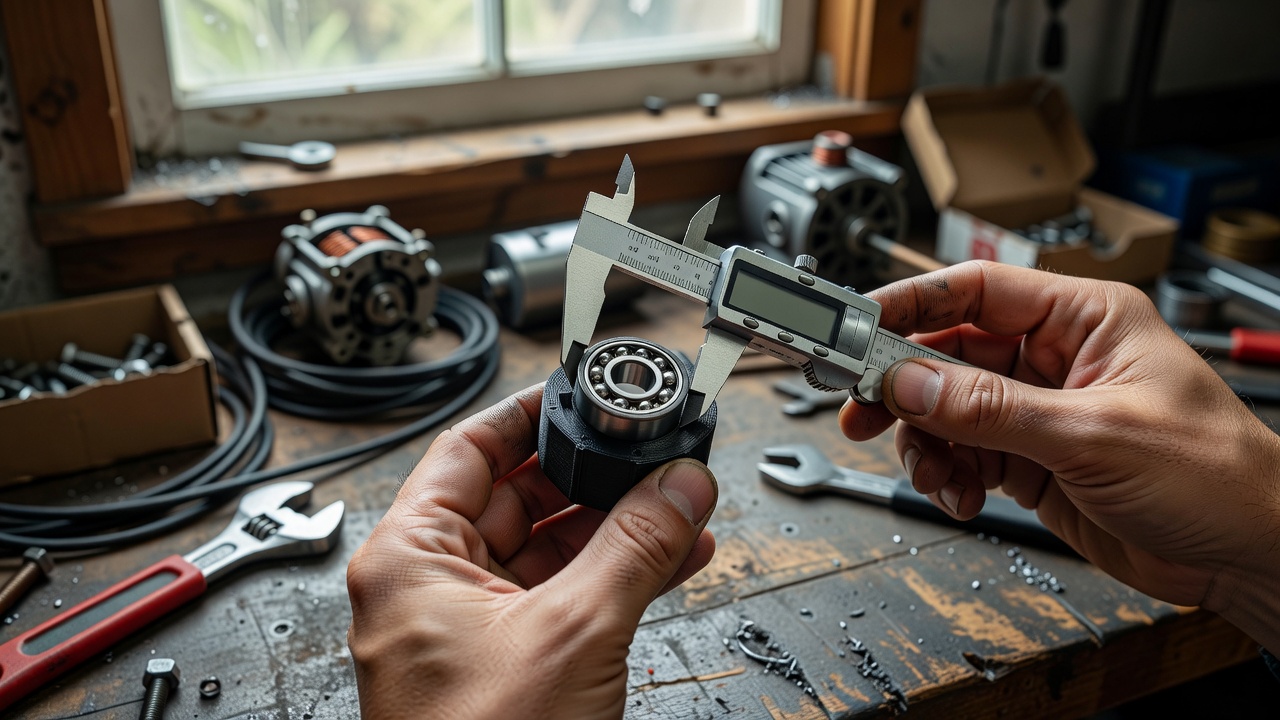
Buy precision, print structure
The 608 bearing — 8 mm bore, 22 mm outside diameter, 7 mm wide — is mass-produced for skateboards and fidget spinners, which makes it one of the cheapest precise components a hobbyist can buy. Pressed into a housing, it gives a small turntable or pulley far smoother rotation than any printed pivot. Similarly, linear guides, ground steel rods and brass bushings carry precision that you would struggle to make yourself.
Lead screws and backlash
Ordinary M8 threaded rod advances 1.25 mm per turn and is cheap, but its nut has noticeable play and friction. A T8 lead screw with a 4-start thread moves 8 mm per turn — faster, smoother and designed for motion. In both cases, backlash appears when the direction reverses: the screw must turn a little before the nut flank contacts again. Anti-backlash nuts use a spring to push two nut halves apart, keeping contact on both flanks at the cost of extra friction.
Choose the fit by function: clearance for sliding, transition for locating, interference for pressed parts that must never move. Write the intent on your drawing, not just the number.
A digital caliper that displays 0.01 mm is commonly specified to about ±0.02–0.03 mm accuracy. For bearing fits, a micrometer or go/no-go gauge tells you more than an extra decimal place.
Tolerances add up across a chain of parts. Worst-case stacking assumes every part is at its limit; root-sum-square estimates assume errors partly cancel. For a handful of hobby parts, design for worst case.
Kinematic couplings: repeatable without tight fits
If a module must come off and go back in exactly the same place — a camera plate, a swappable tool head — a kinematic coupling beats a tight fit. Three balls sitting in three V-grooves constrain all six degrees of freedom exactly once, the approach Douglas Blanding covers in Exact Constraint. A spring or magnet provides preload. Because nothing is over-constrained, the coupling repeats without needing perfect parts.
Why small precision matters
Richard Feynman's 1959 Caltech lecture "There's Plenty of Room at the Bottom" imagined machines building smaller machines. Hobby builds are nowhere near that scale, but the core insight holds: as things shrink, clearances become a larger share of every dimension. A 0.2 mm gap is irrelevant on a door hinge and dominant on a 10 mm gear.
Illustrative dimensions — not verified project measurements
On our own printer, a 0.15–0.25 mm per-side clearance gave sliding fits for printed pins. Your machine, material and slicer will differ; print a test coupon first.
Failure modes to expect
Bearing housing cracks after pressing
Interference too high for plastic. Reduce it, add wall thickness, or design a clamping split housing instead of a press fit.
Stage loses position on reversal
Backlash in the nut or flex in the frame. Add an anti-backlash nut, stiffen the carriage and always approach a target from the same direction.
Smooth motion becomes notchy
Debris on rods or a bent shaft. Clean, check straightness by rolling on glass and keep lubrication light.
Parts fit on the bench, bind in winter
Thermal expansion differences between metal and plastic. Leave room for materials to move, especially on long parts.
"Precision is a budget. Spend it on the one joint that decides the result."Puff Tinker Puzzle bench notes