The awkward bit is usually access, not capacity
Most storage problems are not about running out of space. They are about the back corner of a cupboard you cannot see, the tiny part that hides under a bigger one, or a container that needs two hands to open while you are holding a workpiece. Before buying or building more bins, find the specific moment of friction: reaching, seeing, opening or putting back. Then pick a mechanism that removes that moment.
Grids beat bins
A modular grid turns storage into a repeatable system. Zack Freedman's open-source Gridfinity, released in 2022, uses a 42 mm base pitch and 7 mm height units. Bins in multiples of that pitch drop into a printed or cut baseplate and stay put; optional 6 × 2 mm magnets in the base stop them sliding when a drawer is yanked. Because the grid is shared, a bin made for one drawer fits every other drawer on the same system.
The mechanism here is not glamorous: a stepped profile that locates each bin in two directions. That is exactly why it works. It is repeatable, it is easy to make on most printers, and when a bin breaks you replace one bin. If you prefer not to print, a laser-cut or hand-cut plywood grid on the same pitch gives you the same benefit with bins made from offcuts.
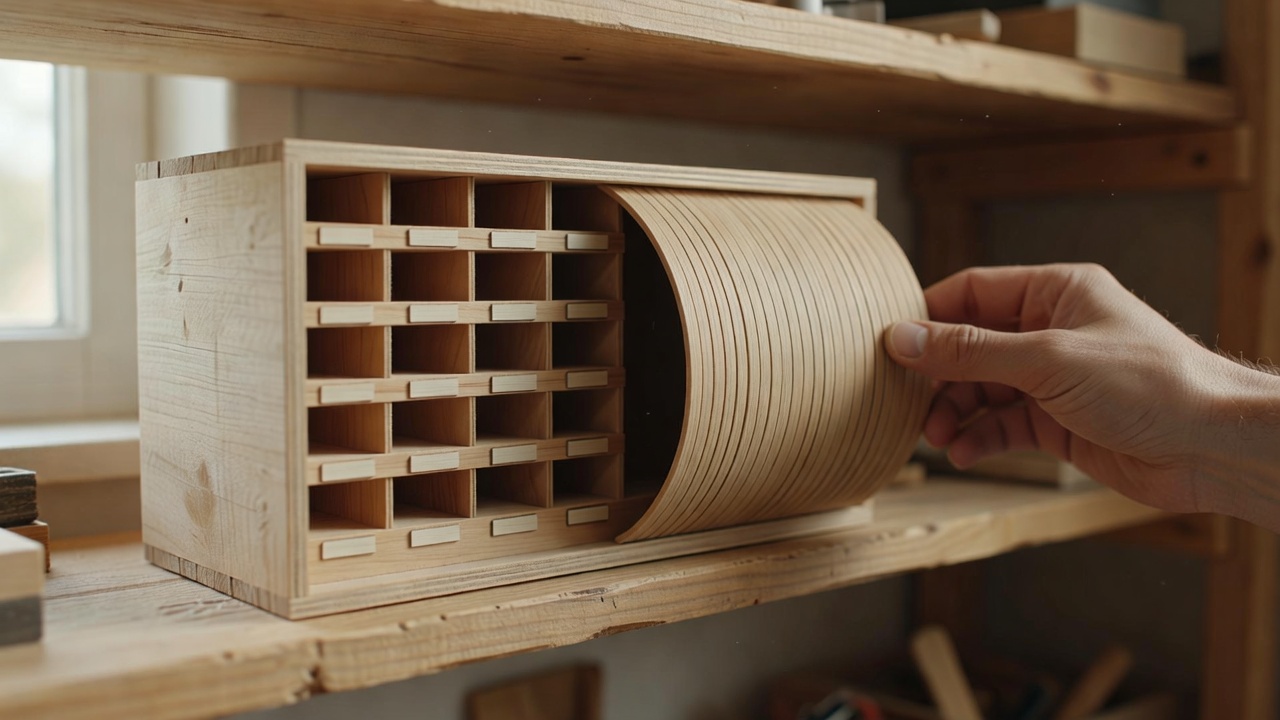
Tambour doors: opening without swing space
A hinged lid needs clearance above it. A tambour door — narrow slats glued to a flexible backing, running in curved grooves — slides back into the box instead. Roll-top desks used the idea in the nineteenth century, and kitchen appliance garages use it now. At small scale it makes a parts box that opens fully on a crowded shelf.
The critical dimension is groove clearance. Too tight and slats bind on the curve; too loose and the door rattles and skews. Round the slat edges that face the groove and keep the curve radius generous so the backing does not crease.
Bring the back to the front: lazy Susans, pull-out trays on drawer runners and pivoting shelves turn dead space into reachable space.
Shallow beats deep for small parts. A single layer of shallow bins shows everything at once; deep bins hide things under other things.
Give every item a shaped home — a foam cut-out, a printed cradle, a pegboard outline. Gaps make missing items obvious, which is the cheapest inventory system there is.
Detents and spring drawers
A drawer that creeps open in a van or on a rolling cart needs a detent: a spring-loaded ball, a flexing tab or a small magnet that holds the closed position until you pull past it. Detents are also what make a rotating carousel stop squarely at each position rather than wherever it coasts. The detent force should be just enough to resist vibration — any more and you need two hands again.
Pegboards and wall systems
Pegboard keeps tools visible, and systems like IKEA's SKÅDIS show how a standard hole pattern lets accessories from many makers interchange. The weak points are the hooks: thin printed hooks under a heavy tool creep and droop over months. Spread loads across two holes, choose tougher materials for load-bearing accessories and keep heavy tools near the bottom.
Illustrative dimensions — not verified project measurements
Our tambour test box was roughly 180 mm wide with 8 mm slats on a cotton backing. We share it to show proportions, not as a cutting list.
Failure modes to expect
Printed bins warp and stop seating
Usually bed adhesion or cooling issues on large flat bases. Add small chamfers, use a brim or split large bins into smaller ones that share the grid.
Detent wears soft
Plastic tabs relax over time. Ball-and-spring plungers or a small magnet with a steel target keep a consistent force much longer.
Tambour slats detach
Glue failing at the backing. Use a flexible adhesive suited to the backing fabric, and avoid tight curves that peel the slat edge every cycle.
Labels become lies
The real maintenance task in any storage system. Make labels easy to change — slide-in cards, chalkboard strips — so they get updated.
"Good storage is the shortest distance between needing a part and holding it."Puff Tinker Puzzle bench notes