Start with the annoyance, not the mechanism
It is tempting to start with a mechanism you admire — a Geneva drive, a ratchet, a toggle clamp — and hunt for somewhere to put it. Resist that. Write down the inconvenience in one sentence: "the cupboard door bumps my hip because the knob sticks out." Then list the motion you need: push, lock, push again, release. Now you are looking for a mechanism with a job description, and you can judge candidates by how much space they take, how many parts they need and how they wear.
Compact mechanisms are rarely new. The Antikythera mechanism, held at the National Archaeological Museum in Athens, packed dozens of bronze gears into a box roughly the size of a shoebox more than two thousand years ago. Henry T. Brown's 1868 catalogue 507 Mechanical Movements illustrates most of the motion conversions a hobbyist will ever need. The modern contribution is mostly in materials and fabrication: printed nylon, laser-cut acrylic and cheap steel springs let you iterate in an afternoon.
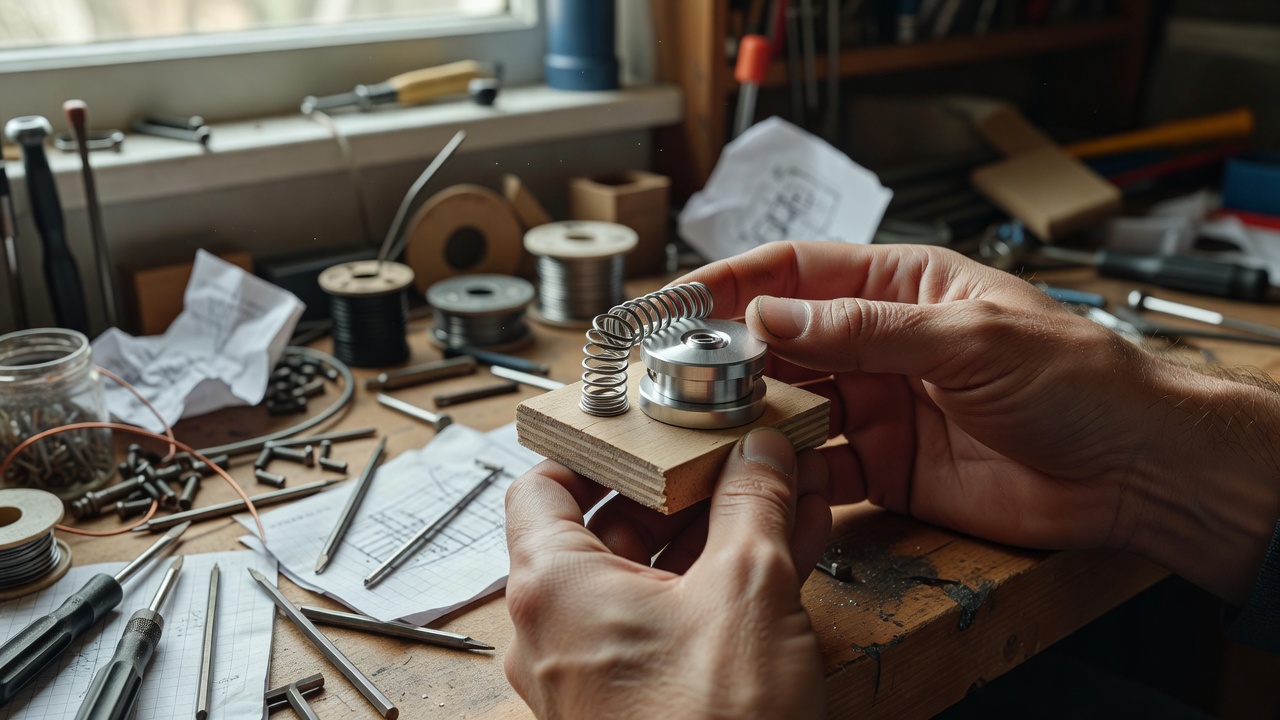
Push-push latches: the heart-shaped track
The handle-free cupboard door relies on a push-push latch. A spring-loaded pin rides in a closed groove shaped roughly like a heart. Push once: the pin climbs one side and drops into the notch at the top, holding the door shut. Push again: the pin is nudged past the notch and the spring returns it down the other side, popping the door open. The same principle — a follower guided through a one-way track — drives many retractable pens and card readers.
What makes it good is repeatability: every cycle follows the same path. What makes it fragile is that path's edges. The notch and the "flip" points take all the impact. In printed parts, those edges round off first, and once they do, the latch occasionally fails to catch. A metal pin, a slightly deeper notch and a spring that is not stronger than necessary all extend life.
Geneva drives: rotation in clean steps
When you need something to turn and then stop — a carousel of bit holders, a dial that advances one day at a time — the Geneva drive is the classic answer. A continuously rotating drive wheel carries a pin that enters a slot in a star-shaped wheel, turns it one step and leaves. A raised locking disc on the drive wheel keeps the star wheel from drifting between steps.
For a four-slot star wheel, the star wheel moves during 90° of drive rotation and rests for the other 270°. Six slots give 60° steps with a longer motion phase. The geometry works best when the pin enters each slot tangentially; that is why the drive and star wheel centres sit at a fixed distance that depends on slot count. Get that distance wrong and indexing becomes a jolt rather than a glide.
Sketch the motion as a sequence before choosing parts: input, intermediate state, output, reset. If your sequence has a "hold" step, you need a detent, notch or locking surface somewhere.
Followers need room to move but not to wander. On printed parts, test a coupon with several groove widths in 0.1 mm steps and keep the narrowest that runs freely after 100 cycles.
Design so the wearing part is the cheap part. A replaceable brass pin or a screw-in follower lets you service the mechanism instead of reprinting the housing.
Compliant mechanisms: fewer parts, more flex
Every pin joint is a place where dirt collects and clearance grows. Compliant mechanisms replace joints with deliberately flexible sections. The living hinge on a flip-top bottle cap is the everyday example; Larry Howell's research group at Brigham Young University has shown how far the idea goes, from bistable switches to deployable structures.
For a hobbyist, a printed flexure can replace a spring and a pivot in one part. The catch is fatigue. A flexure bent too far, or in a material that does not tolerate repeated strain, cracks without warning. Polypropylene and nylon handle repeated flexing well; brittle printing plastics often do not. Keep deflection modest and make flexures long and thin rather than short and thick.
Illustrative dimensions — not verified project measurements
A printed bistable clip we sketched for a cable tidy used a 20 mm flexure about 0.8 mm thick. Treat numbers like these as starting points to test, not specifications.
Failure modes to expect
Follower skips the track
Usually a worn notch edge or a groove that is too shallow. Deepen the catch, harden the follower or reduce spring force so impacts are gentler.
Pin wear opens up the clearance
Plastic pins in plastic slots wear quickly. Swap in a steel dowel or brass rod and the plastic becomes the surface that stays true.
Flexure fatigue cracks
Reduce the strain: lengthen the flexure, thin it out or change material. Cracks typically start at sharp corners, so add generous fillets.
Springs take a set
A spring compressed close to its limit for months loses force. Size springs so normal operation uses well under their maximum travel.
"The good compact mechanism is the one you forget is there — until you need to open it with a screwdriver, and it lets you."Puff Tinker Puzzle bench notes